

How Florida Homeowners Can Avoid Common Issues With Saltwater Pools
If you’re interested in installing a home swimming pool, you may be surprised to discover that choosing a saltwater pool entails several benefits. The water is considered soft and gentle on the skin, and you can avoid harsh, chemical smells.
In addition, your trusted Florida pool builder will tell you it’s generally easier to maintain. Like any pool, however, it will require some upkeep to prevent common issues, such as chemical imbalance, mineral scaling, and corrosion. Here are a few tips and tricks to keep your saltwater pool in ship-shape and ready for use.
Maintain an Appropriate Salt Level in Your Pool
Saltwater pools don’t need chlorine added because it’s already in the salt. A piece of equipment called a salt chlorine generator uses electrolysis to convert salt in the water into a sanitizing agent.
Instead of adding chlorine to the pool, you’ll simply increase salt levels as needed. Ideally, you want to maintain salinity around 3,200 parts per million (ppm) using high-purity pool salt, although a range of about 2,700–3,400 ppm is acceptable.
It’s important to run the pump long enough to ensure all the water is circulated daily, and to add salt while the pump is running.
Rainwater can affect salinity, so make sure to check levels following storms. Don’t forget that salt can increase pH or the alkalinity, so you may need to adjust chemically or mechanically to compensate.
Perform Weekly and Monthly Chemical Tests
The balance of chemicals in your pool can impact how the water feels, whether it’s irritating to the skin or feels soft and silky.
A knowledgeable Florida pool builder will likely recommend testing water chemistry weekly to gauge pH, free chlorine, and total alkalinity. Monthly testing should include salinity, calcium hardness, and cyanuric acid (a stabilizer).
Testing allows you to make adjustments that keep your system in balance, prevent damage, and keep water feeling pleasant on your skin.
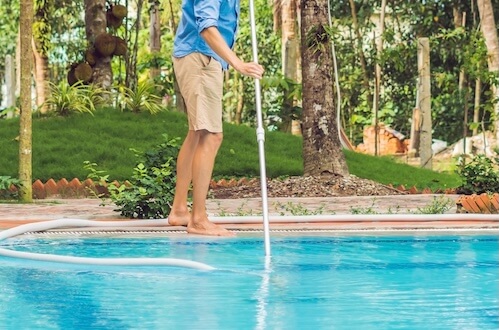
To preserve a balanced pool system, you’ll also want to perform weekly cleaning. This includes skimming debris, emptying pump baskets, and brushing and vacuuming pool walls. A saltwater-compatible, robotic pool cleaner will save you time and hassle.
Schedule Regular Salt Cell Maintenance and Cleaning
The salt cell is a component of the salt chlorine generator that is responsible for converting salt into chlorine through the process of electrolysis. To continue working properly, this vital component must be cleaned regularly.
Florida’s water is high in minerals like calcium that can leave scale and deposits, fouling salt cells. When this occurs, you could find yourself dealing with issues like cloudy water, chemical imbalance, and even algae growth.
To prevent scale buildup, inspect and clean your salt cell at least every three months. Cleanse it with a diluted acid-water solution formulated to remove scaling.
Prepare for Seasonal Storms
Seasonal hurricanes are part of life in The Sunshine State. If you have a pool, you may naturally worry about the prospect of excess water during storms.
However, this doesn’t mean you should preemptively empty your pool. An experienced Florida pool builder will tell you it’s better to leave it full.
You may think it will overflow, but if your builder has done the job right, the decking will funnel overflow away from the pool and your home, so you needn’t waste water by draining it. You can drain away excess water after the fact.
For saltwater pools, specifically, your best bet is to use a pool cover to protect the integrity of the ecosystem and prevent debris from falling in. Before a storm hits, turn off pumps and salt chlorinators. Afterward, clear debris, check the salt cell, and balance your pool’s chemistry before turning everything back on.
Observe Off-Season Maintenance
Florida homeowners don’t need to winterize their pools, as there’s very little chance of freezing weather. However, you may use your pool very little, or not at all, during the off-season.
You can cut back on maintenance during low-use periods, but you still need to maintain a standard of care to preserve pool equipment and make sure the pool is ready for use later.
Your Florida pool builder may recommend a cover to protect against debris and maintain heat. Since saltwater generators can be less efficient in cold water, retaining heat is important. If you don’t have a cover, you’ll have to check and balance chemicals more frequently.
A cover also means you won’t have to clean your pool as frequently, and you can likely reduce the time the pump runs. What you don’t want to do is drain the pool, as it can cause a variety of issues, such as algae growth or hydrostatic pressure damage, that make your pool harder to restore to working condition.
Protect Your Saltwater Pool Against Corrosion
The combination of salt and water can spell trouble for metal parts, and your pool may have several. This happens in chlorine pools, as well, since chlorine is salt-based, but saltwater pools have about 10 times more salt.
If you want to protect ladders, railings, light fixtures, pump and heater parts, and other metal elements from corrosion, start by installing the right products. Look for marine-grade stainless steel parts designed for use in saltwater systems. From there, you can add zinc anodes (known as sacrificial anodes) to protect metal parts.
When installed in conjunction with metal components, zinc undergoes galvanic corrosion, an electrochemical process in which a more active metal (zinc, in this case) corrodes at an accelerated rate while protecting the more reactive metal (steel). In other words, you’re sacrificing the anode to protect more expensive, functional parts.
Collaborate With a Trusted Florida Pool Builder to Create an Outdoor Oasis
Installing a saltwater pool is a great way to bring the beachside to your backyard. With proper preparation and maintenance, you can ensure a pleasant swimming experience year-round.
Are you interested in the prospect of a saltwater swimming pool? The qualified team at Tampa Bay Pools is here to help you create the outdoor oasis of your dreams. Contact us now to discuss your project and request an estimate.